


You play a powerful card, ready to claim victory, but your opponent calmly says, “In response…” and suddenly the game goes sideways. If you’ve ever felt lost in that moment, wondering whose card actually resolves first, you are not alone. That single interaction is the key difference between the straightforward turn-taking of a game like Uno and the dynamic flow of many modern card games. Check out ufa169 to know more
The phrase “chain card game” can describe two completely different styles of play. One type involves building a sequence, like placing cards in numerical order on the table. This is about a predictable turn-by-turn progression, where a winning strategy relies heavily on managing the cards in your hand to fit that order.
This guide focuses on the other, more complex kind of chain: the one that happens when multiple effects are triggered at once. In many of today’s most popular games, playing a card doesn’t mean its effect is instant. Instead, it opens a window for others to react, creating a pile-up of actions. Understanding how to navigate that moment is the secret to feeling confident and in control. We will unravel that exact scenario, breaking down the “chain” mechanic into simple, easy-to-understand steps so you can learn to master it.
First, Are You Playing a “Sequence” or an “Effect-Chain” Game?
Before diving into the wild world of modern card game rules, it’s important to know what kind of game you’re actually playing. The word “chain” can describe lining up cards in order, but in many popular games today, it means something entirely different.
You are likely familiar with games where the goal is to build a sequence of cards on the table. A classic example is the Fan Tan card game, sometimes called Sevens. The rules are straightforward:
- Someone starts by playing a specific card (like the 7 of hearts).
- On your turn, you must play the next card up or down in that suit (the 8 or 6 of hearts).
- If you can’t play a card, you pass.
- The first person to empty their hand wins.
In a sequence-building game, you are creating a physical line of cards, one per turn. The “chain” is a visual sequence like 5-6-7-8 that grows over time. An effect-chaining game, however, is about a stack of actions that all trigger in a single, chaotic moment before any of them actually happen.
So, when you see cards lined up neatly on the table, you’re likely in a sequence game. But if your opponent shouts “In response!” after you play a card, you’ve entered the world of effect-chaining.
From Uno to “In Response!”: The One Rule That Changes Everything
Think about a game like Uno. When you play a “Draw 4” card, the next player immediately grabs four cards. The action is instant and unstoppable. For many of us, this is how card games are supposed to work: you play a card, its effect happens, and the turn moves on. But the moment an opponent says “in response!” that simple sequence is broken by a single, crucial rule.
The most important new rule is that when you play a card, its effect is not instant. Instead, imagine your card hovers over the table for a moment. You’ve announced your move, like saying, “I’m playing this card to draw two cards!” But before you actually get to draw them, the game pauses, giving every other player a chance to react.
This brief pause is the foundation for all complex card game rules for making chains. It’s a tiny window where your opponent can play a card specifically to interfere with yours. This opportunity to react is the core of modern card game strategy, turning a simple turn into a dynamic exchange.
What Is a “Chain”? Thinking Like a Conversation with Interruptions
That back-and-forth, where one card is met with another, is best understood as a conversation full of interruptions. Imagine you make a statement (“I’m playing a card to draw!”). Before you can finish your thought and actually draw, your friend cuts in with a counterpoint (“Not if I cancel it!”). This series of actions and reactions, all happening before anyone’s card does its thing, is called a Chain. It’s a way to organize a sequence of plays that are all linked to a single starting move.
When your opponent plays a card during that brief pause after your action, they are choosing to respond. They are adding their voice to the conversation, creating another link in the chain. This is the core of card game strategy for long sequences; it’s not just about what you play on your turn, but how you react during everyone else’s.
Let’s keep it simple. You play a card, say, “Giant Growth,” to make your creature bigger. Your opponent sees this and, in response, plays “Shrink Ray” to make that same creature smaller. Now you have a two-link chain: your Giant Growth is the first link, and their Shrink Ray is the second. Both cards are on the table, waiting to happen.
For a card’s effect to finally happen, we say it resolves. This is the moment the magic happens—damage is dealt, cards are drawn, or creatures are changed. But they don’t resolve in the order they were played. To figure that out, you need to learn the one golden rule of chains.
The Golden Rule: Why the Last Card Played Is the First to Happen
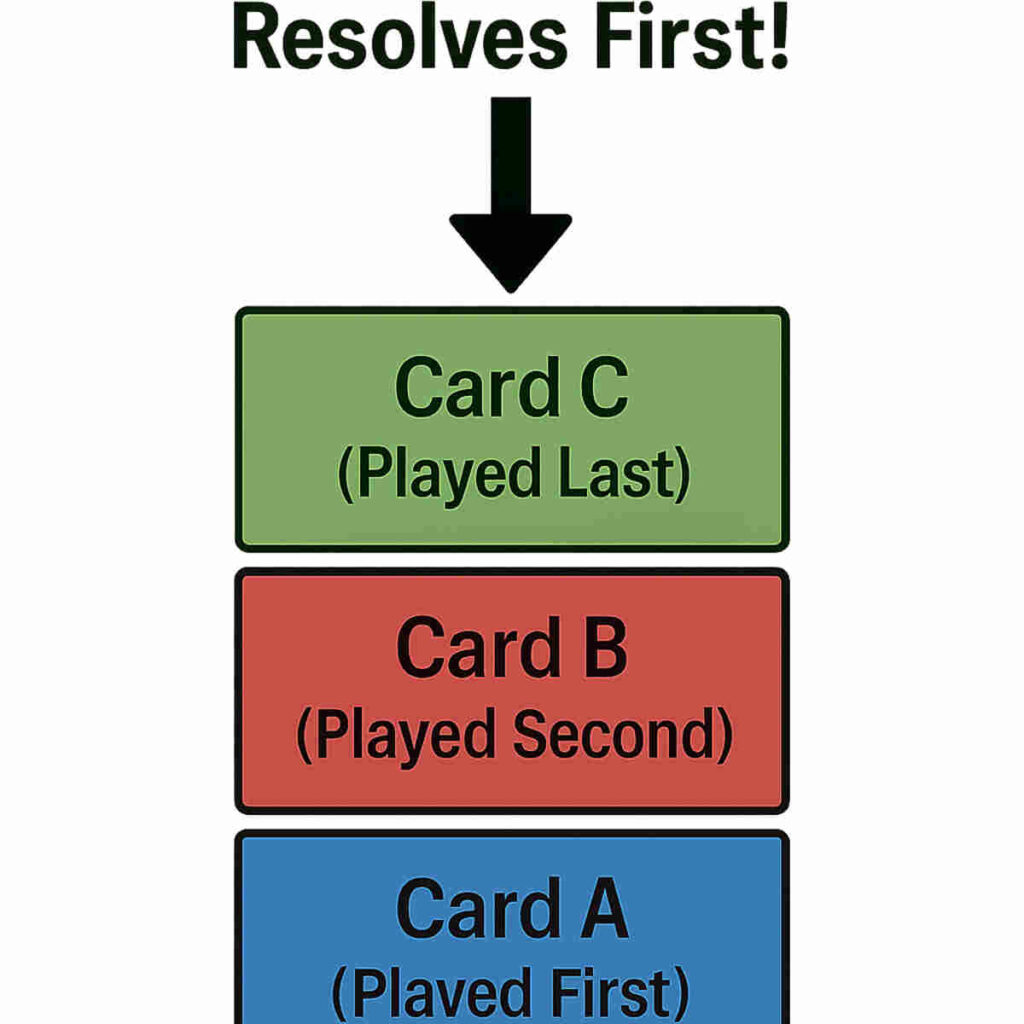
To figure out which card resolves first, you have to ignore your instincts. In most things, from waiting in line to watching a race, the first one to start is the first one to finish. Card game chains work the opposite way. The golden rule is simple: the last card played is the first one to happen. The best way to picture this is to think of a stack of plates. You place the first plate down, then someone puts another on top of it, and a third on top of that. To get to the bottom plate, you have to take the top one off first.
Your chain of cards works exactly like that stack. The first card played (Card A) is the bottom of the stack. The response (Card B) goes on top. Any further response (Card C) is placed on the very top. To clear everything, you must start from the top. Card C resolves first. Once it’s done, Card B gets its turn. Finally, with everything else out of the way, your original Card A gets to resolve.
This “last in, first out” order is the single most important concept for following the action. It explains why your opponent’s last-second play can completely undo your brilliant first move. Once you get used to picturing the chain as a stack that resolves from the top down, you’ll never feel lost in the middle of a turn again.
Your First Chain: How a Simple “Response” Can Thwart a Powerful Card
Seeing this rule in action is what makes it click. Let’s walk through a classic game scenario. Imagine it’s your turn, and you’re ready to unleash a powerful spell—a card called ‘Fireball’ that deals 3 damage directly to your opponent. You play it, creating the bottom of our stack.
But it doesn’t happen right away. Your opponent, seeing your move, says, “In response, I play ‘Water Shield’!” Their card’s effect is simple: it cancels the next 3 damage dealt to them. ‘Water Shield’ is now placed on top of your ‘Fireball’ in the chain. Since no one else adds a card, we now resolve the chain using our golden rule.
Remember, the last card played is the first one to happen.
- Your opponent’s Water Shield (the last card played) resolves first. A protective barrier is now active.
- Your Fireball (the first card played) finally tries to resolve. It launches, but the damage is completely absorbed by the already-active shield. The final result: no damage is dealt.
Even though you made the first move, your opponent’s timely response completely neutralized your play because it resolved first. This interaction is the heart of modern card game strategy, transforming the game from simple turn-taking into a dynamic conversation of moves and counter-moves.
Winning with Chains: How to Save Your Creatures at the Last Second
Seeing your best card get canceled is frustrating, but this same mechanic can be used to your advantage. Chains aren’t just for stopping an opponent’s plan; they’re also for perfecting your own. You can respond to any action, including one that targets something you control, opening up a world of last-second saves and surprise power-ups.
Let’s imagine your opponent tries to destroy your “Goblin Archer” with a “Lightning Bolt” spell. This is their move, and it starts the chain. Instead of accepting your creature’s fate, you have a card called “Giant Growth” that makes a creature stronger. You declare, “In response, I play Giant Growth on my Goblin Archer.” Your card is now on top of their “Lightning Bolt” in the chain.
Following the golden rule, the last card played resolves first. Your “Giant Growth” happens immediately, making your Goblin Archer bigger and tougher before the damage hits. Next, their “Lightning Bolt” resolves, but it’s no longer strong enough to destroy the newly empowered creature. Your Goblin Archer survives, and your opponent has wasted a valuable card.
This is the next level of card game strategy. By waiting for your opponent to act first, you forced them to commit, then used the chain to turn their own move into a failure. You didn’t just react; you seized control of the timing.
Untangling a 3-Card Pile-Up: A Step-by-Step Walkthrough
This intricate dance of action and reaction can feel like a high-speed argument, but even when a third or fourth card is added, the rule remains the same.
Imagine this scenario: It’s your turn, and you play “Ancestral Knowledge,” which lets you draw two new cards. Your opponent, not wanting you to get ahead, immediately responds by playing “Spell Shatter” to cancel your card. The chain now has two links. But you were prepared. You respond to their cancellation by playing one last card: “Denial,” which can cancel another cancellation card.
How does this messy pile-up resolve? We just follow our golden rule: the last card played is the first one to happen.
Let’s break down the order:
- Your “Denial” (the last card played) resolves first. It successfully cancels your opponent’s “Spell Shatter.”
- Next, the chain looks to your opponent’s “Spell Shatter.” It tries to resolve, but since your “Denial” already cancelled it, it does nothing. It’s a dud.
- Finally, the chain reaches your original card, “Ancestral Knowledge.” With nothing left to stop it, it resolves successfully, and you draw two cards.
By having the final say, you protected your original move. Even though your opponent tried to interrupt you, your response to their response gave you control. This is the heart of interactive card games—not just playing a card, but winning the entire chain.
From Confused to Confident: 3 Steps to Master Your Next Game
The next time a player at the table says, “In response,” you won’t feel a wave of confusion. Instead, you’ll see an opportunity. You’ve now unlocked the single most important rule that separates simple card games from modern ones. That moment of back-and-forth action is no longer an obstacle; it’s a puzzle you now have the key to solve.
The secret is remembering one golden rule: Last In, First Out. To turn this knowledge into confidence, use this simple action plan in your very next game.
Your 3-Step Action Plan:
- Play your card and clearly announce what it does.
- Pause and ask the table, “Any responses?”
- If there are responses, stack them up mentally and resolve them from the last one played.
This small habit is the first step toward developing a real card game strategy. You’re no longer just playing cards; you’re seeing the game’s flow. Soon you’ll anticipate plays and spot clever strategies. Whether you’re diving into a complex trading card game or trying a new strategic title with friends, you now have the tools to follow the action and play with confidence. Welcome to the game.